Why SMS Is Still the Backbone of Banking Communication in Nepal
Think about the last time your bank reached out to you instantly. Chances are, it wasn’t an email. It wasn’t a push notification. It was a text message.
For banks and financial institutions in Nepal, from large commercial banks to cooperative societies and microfinance institutions, SMS remains one of the most trusted, fast, and reliable channels for communicating with customers. And in 2026, its importance has only grown.
Nepal has over 40 million active mobile subscribers, yet internet penetration, especially in Terai districts and hilly regions, is still uneven. A customer in Jumla or Dang may not have consistent mobile data, but they almost certainly have a basic phone that receives SMS. For banks that operate across all 77 districts, this makes SMS not just convenient, it’s essential.
This guide breaks down exactly how banks in Nepal use SMS today, which types of messages deliver the most value, and the best practices for getting it right.
1. OTP and Two-Factor Authentication
The most critical use of SMS in banking is OTP (One Time Password). Every time a customer logs into mobile banking, approves a transaction, or resets their PIN, a secure OTP is sent to their registered number within seconds.
This is non-negotiable for any bank operating in Nepal today. The Nepal Rastra Bank (NRB) mandates strong authentication for digital transactions, and SMS OTP is the most widely used method to meet this requirement.
Why SMS OTP is preferred over app-based authentication in Nepal:
For a country where a significant portion of the banking population uses basic smartphones or feature phones, app-based authenticators simply aren’t accessible to everyone. An SMS OTP works on any phone, any network, without internet, in every corner of the country.
Speed and reliability are everything here. A delayed OTP means a failed transaction and a frustrated customer. This is why banks in Nepal look for SMS providers with gateway delivery speeds of under a second and 99%+ uptime.
2. Transaction Alerts and Account Activity Notifications
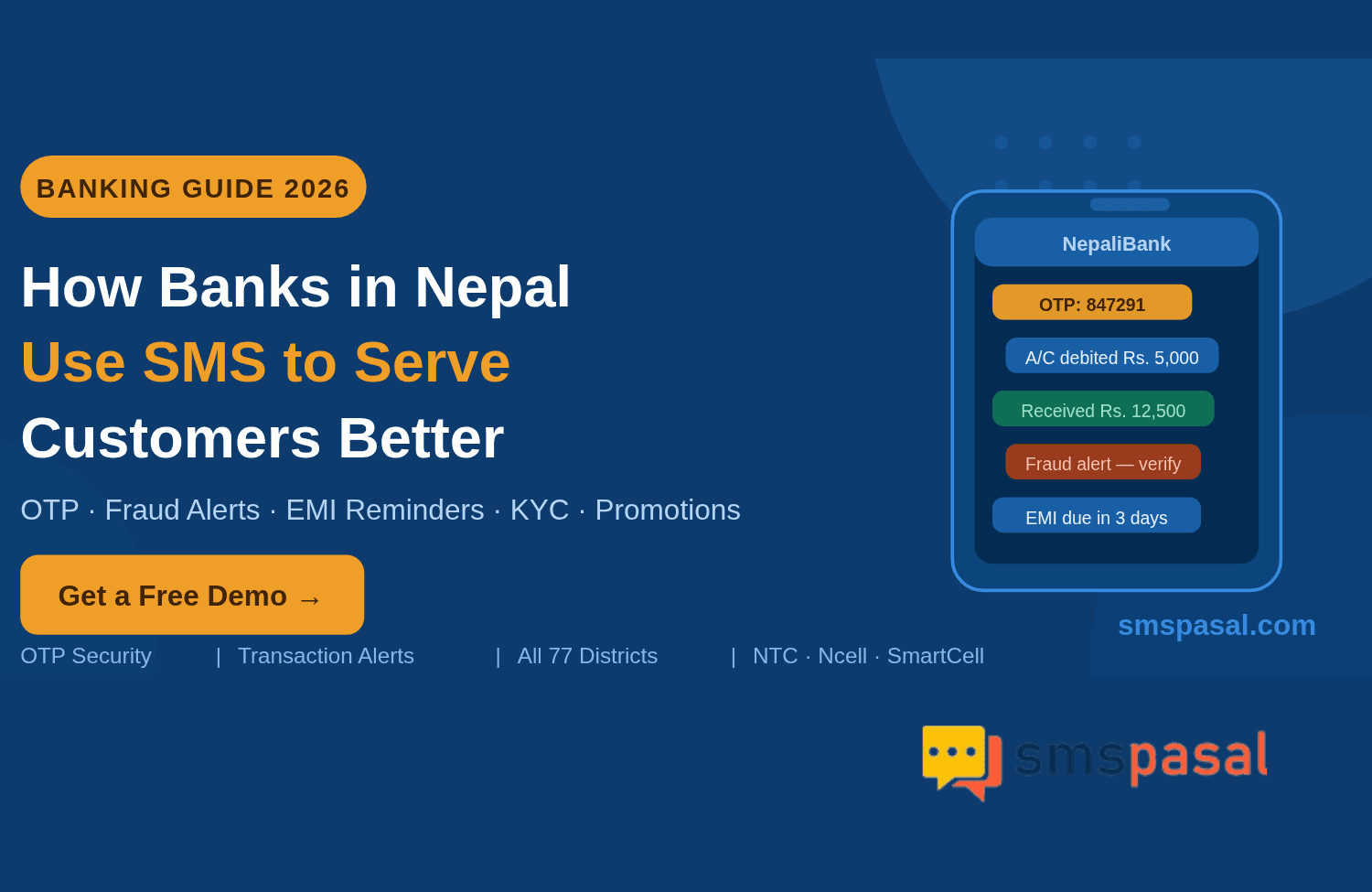
Every debit, credit, ATM withdrawal, or fund transfer should trigger an instant SMS alert to the customer. These are called transactional SMS, and they serve two purposes simultaneously: keeping customers informed and acting as the first line of fraud detection.
Common transactional SMS alerts sent by Nepali banks:
- “Your account XXXX1234 has been debited Rs. 5,000 via ATM on [date/time].”
- “You have received Rs. 12,500 from [sender] via RTGS. Balance: Rs. 87,340.”
- “A login attempt was detected on your internet banking account at [time]. If not you, call 1234.”
These messages build customer confidence. Understanding how banks in Nepal use SMS for transaction alerts reveals why open rates for these messages consistently sit above 90%, customers read them immediately because they matter.
3. Fraud Alerts and Security Warnings
Financial fraud is a growing concern in Nepal, particularly as digital payments via eSewa, Khalti, and mobile banking have expanded rapidly. Banks need a direct channel to warn customers the moment suspicious activity is detected.
SMS is the most effective channel for this because it doesn’t rely on the customer opening an app or checking email. A fraud alert SMS cuts through everything.
Examples:
- “ALERT: Unusual login detected from a new device. If this wasn’t you, call us immediately at [number] or visit your nearest branch.”
- “Your debit card has been temporarily blocked due to suspicious activity. Please call [number] to unlock.”
Speed is critical. A fraud alert that arrives 10 minutes late is too late. Banks using automated SMS gateway systems can trigger these alerts the moment the fraud detection system flags activity, with zero manual intervention.
4. Loan and EMI Payment Reminders
For banks and microfinance institutions managing large loan portfolios, SMS reminders for upcoming EMI due dates are one of the most practical and cost-effective tools available.
Sending a reminder 3–5 days before an EMI due date reduces late payments, minimizes the volume of follow-up calls from collections staff, and maintains positive customer relationships. A reminder SMS feels helpful rather than aggressive, which is exactly the tone banks want to maintain.
Examples:
- “Dear [Name], your EMI of Rs. 8,500 for loan A/C XXXX is due on March 25. Please ensure funds are available. ,[Bank Name]”
- “Reminder: Your home loan EMI of Rs. 22,000 is due in 3 days. Pay via mobile banking or visit your nearest branch. ,[Bank Name]”
For cooperative societies and microfinance institutions operating in rural Nepal, where personal relationships and trust are central to the business, a timely SMS reminder can meaningfully reduce default rates without the need for costly field visits.
5. Account Balance and Mini Statement Requests
Many banks in Nepal allow customers to request their account balance or mini statement via SMS. The customer sends a keyword to a short code, and the bank’s system automatically replies with their balance or the last 3–5 transactions.
This is especially valuable for customers in remote areas who don’t have easy access to a branch or ATM, and for customers who prefer not to use mobile banking apps.
This kind of interactive bulk SMS service requires robust SMS API integration between the bank’s core banking system (CBS) and the SMS gateway provider.
6. New Product and Service Promotions
Banks in Nepal regularly launch new products, fixed deposit schemes, home loan offers, credit card promotions, savings account bonuses, and more. Reaching the right customers with the right offer at the right time is where promotional SMS comes in.
Unlike transactional SMS (which goes to all customers for every action), promotional SMS campaigns are targeted. A bank can segment its customer database and send:
- Fixed deposit promotions to customers with large current account balances
- Home loan offers to customers in a specific age group or location
- Credit card offers to customers with high transaction volumes
Important distinction: In Nepal, banks must be careful to distinguish between transactional SMS routes (for alerts and OTPs) and promotional SMS routes (for marketing). Mixing the two on the wrong route can lead to regulatory issues or delivery failures. A reliable SMS provider will help banks set up the correct routing for each type.

7. Branch and ATM Notifications
When a branch changes its hours, an ATM is temporarily out of service, or a new branch opens in a customer’s area, SMS is the fastest way to communicate this to relevant customers.
Rather than waiting for customers to show up and be disappointed, banks can proactively notify affected customers, building trust and reducing frustration.
8. KYC and Compliance Reminders
Nepal Rastra Bank requires banks to maintain updated KYC (Know Your Customer) records for all account holders. Many banks in Nepal use SMS to remind customers whose KYC documents are due for renewal, avoiding account freezes and maintaining regulatory compliance.
Example:
- “Dear [Name], your KYC for account XXXX expires on April 30. Please visit your nearest branch with a valid ID to update your records and avoid account restrictions. ,[Bank Name]”
This kind of proactive communication saves both the customer and the bank from unnecessary friction.
How Banks in Nepal Use SMS Well: Best Practices to Follow
Getting SMS communication right in banking requires more than just sending messages. Here are the principles that separate good bank SMS programs from great ones:
Keep it clear and concise. A banking SMS should convey one piece of information in plain language. Avoid jargon. Use the customer’s name, the account number (last 4 digits only for security), the amount, and the action required.
Send at appropriate times. Transaction alerts should go out immediately, 24/7. Marketing messages should be sent during business hours, ideally mid-morning or early evening.
Use a recognizable Sender ID. Customers should immediately know the message is from their bank. A registered Sender ID (e.g., “NBBANK” or “KUMARIBNK”) builds trust and reduces the risk of customers ignoring or deleting the message.
Separate your routes. Use transactional SMS routes for OTPs and alerts; these require guaranteed delivery and bypass DND (Do Not Disturb) filters. Use promotional routes for marketing messages.
Integrate with your core banking system. The most effective bank SMS programs are fully automated. When a transaction occurs, the SMS fires automatically. Manual SMS campaigns are slow, error-prone, and don’t scale.
Choosing the Right SMS Partner for Your Bank
For any bank or financial institution in Nepal, choosing an SMS provider is not just a technology decision; it’s also a compliance and customer-experience decision.
The right SMS partner should offer dedicated transactional SMS routes for OTPs and alerts, a robust SMS API that integrates with core banking systems, registered Sender ID support, real-time delivery reporting, data security and encryption, coverage across all networks (NTC, Ncell) in all 77 districts, and local support with expertise in Nepal’s telecom regulations.
👉 SMS Pasal’s dedicated solution for banks and financial institutions in Nepal addresses all these needs. To see the full range of features, use cases, and how SMS Pasal specifically supports Nepali banks, visit our Bulk SMS for Banks and Financial Institutions page.
Contact us
📞 Call us: 9845398624
📧 Email:smspasalofficial@gmail.com

Conclusion: SMS Is a Strategic Asset for Nepali Banks
In an era of digital banking, it might seem like SMS is old technology. But in Nepal’s banking sector, where customers are served across urban centers and remote districts alike, SMS is anything but outdated. It’s the communication backbone that keeps customers informed, transactions secure, and relationships strong.
Understanding how banks in Nepal use SMS, from OTP authentication to fraud alerts, loan reminders to KYC compliance notices, shows that SMS touches nearly every critical moment in a bank customer’s journey. The banks that use it well, reliably, clearly, and at the right moment, build a level of customer trust that no social media campaign can replicate.
If your bank or financial institution is looking to strengthen its customer communication with fast, secure, and affordable SMS solutions, SMS Pasal is ready to help.
FAQs
1: Do all banks in Nepal use SMS for customer communication?
Most commercial banks (Class A) and development banks licensed by Nepal Rastra Bank use SMS for at least transactional alerts and OTP.
2: What is the difference between transactional SMS and promotional SMS for banks?
Transactional SMS is an automated message triggered by account activity, OTPs, debit/credit alerts, fraud warnings, and EMI reminders. These are sent 24/7 and bypass DND filters. A promotional SMS is a marketing message for new product launches, fixed deposit offers, or seasonal campaigns, sent during business hours to opted-in customers only.
3: Is SMS banking safe for customers in Nepal?
Yes, when implemented correctly. Banks use encrypted SMS channels, registered Sender IDs, and one-time passwords that expire within seconds. Customers should always verify the sender name and never share OTPs with anyone, including people claiming to be bank staff.
4: How quickly are banking SMS alerts delivered in Nepal?
Transactional alerts and OTPs are typically delivered within seconds across NTC, Ncell, and SmartCell networks. Delivery speed depends on the quality of the SMS gateway provider. Banks should use providers with 99%+ uptime and direct network routing.
5: Can banks in Nepal send SMS in the Nepali language?
Yes. SMS providers that support Unicode enable banks to send messages in the Nepali script (देवनागरी). This is particularly useful for communicating with customers in rural districts who are more comfortable reading Nepali than English.
6: Does SMS banking work in remote areas of Nepal?
Yes, this is one of SMS’s biggest advantages over app-based banking. SMS works on any basic mobile phone without internet or data, making it the most reliable channel for reaching customers in hilly and Terai regions where smartphone penetration and data connectivity are still limited.
7: How do banks integrate SMS with their core banking system?
Banks connect their Core Banking System (CBS) to an SMS gateway via API. Once integrated, messages fire automatically when a transaction or event is triggered, no manual sending required. A reliable SMS provider will offer detailed API documentation, developer support, and compatibility with major CBS platforms used in Nepal.
8: What should a bank look for when choosing an SMS provider in Nepal?
The key factors are delivery speed and uptime; dedicated transactional routes that bypass DND; registered Sender ID support; SMS API compatibility with core banking systems; coverage across all 77 districts on NTC, Ncell, and SmartCell; data security and NTA compliance; and local customer support.